 relanote
Architecture Overview
This document explains the internal architecture of Relanote, from source code to audio output.
System Architecture
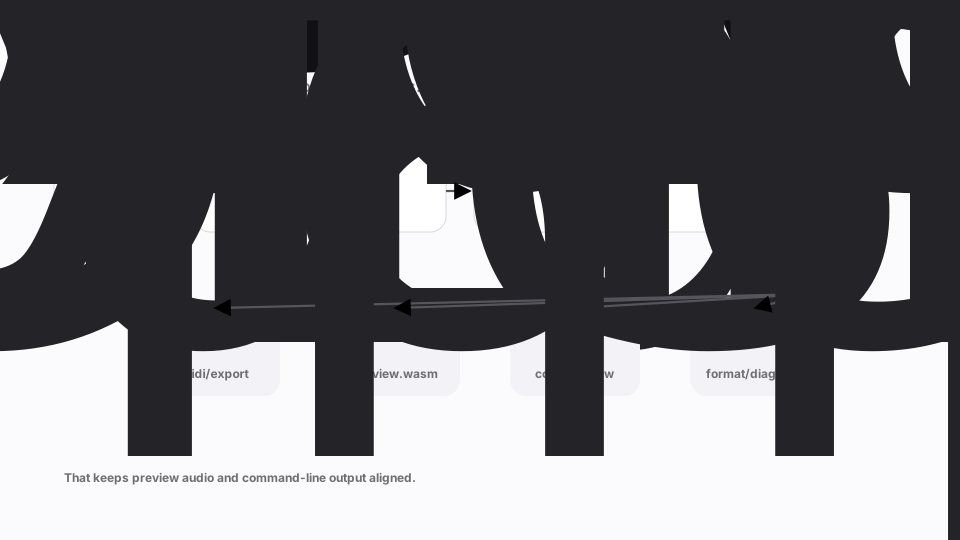
Package Structure
Relanote is organized as MoonBit packages:
| Package | Purpose |
core | Source files, spans, diagnostics, reports |
lexer | Tokenizes source code into tokens |
ast | Defines AST (Abstract Syntax Tree) types |
parser | Parses tokens into AST |
hir | Holds the lowered representation |
resolver | Resolves modules and names |
types | Infers and checks types |
eval | Evaluates AST and produces music values |
stdlib | Standard library prelude, scales, chords, synth presets |
render | Renders music values to MIDI bytes |
format | Code formatter |
lsp | Editor protocol framing and dispatch |
cmd | Command-line interface |
studio | Vapor Moon playground view and bridge |
Compilation Pipeline
1. Lexical Analysis (Lexer)
The lexer transforms source code into tokens:
Source: "let melody = | C4 E4 G4 |"

Tokens:
  ├─ Keyword(Let)
  ├─ Identifier("melody")
  ├─ Operator(Eq)
  ├─ Pipe
  ├─ Pitch(C4)
  ├─ Pitch(E4)
  ├─ Pitch(G4)
  └─ Pipe
2. Parsing (Parser)
The parser constructs an Abstract Syntax Tree:
AST:
  └─ LetBinding
       ├─ name: "melody"
       └─ value: Block
                   └─ notes: [C4, E4, G4]
3. Evaluation (Evaluator)
The evaluator transforms AST into concrete music values:
Value:
  └─ Block {
       notes: [
         Note { pitch: 60, duration: 1.0, velocity: 80 },
         Note { pitch: 64, duration: 1.0, velocity: 80 },
         Note { pitch: 67, duration: 1.0, velocity: 80 },
       ],
       synth: None,
       tempo: 120,
     }
4. Rendering (Render)
The renderer converts music values to playable formats:
- MIDI - For DAW integration and hardware synths
Data Flow Example
Here's how a simple melody flows through the system:
; Input .rela file
scale Major = { R, M2, M3, P4, P5, M6, M7 }
let melody = | <1> <3> <5> | |> voice Lead
melody┌────────────────────────────────────────────────────────────────┐
│ 1. Parser reads scale definition and melody │
└────────────────────────────────────────────────────────────────┘
│
▼
┌────────────────────────────────────────────────────────────────┐
│ 2. Evaluator resolves <1> <3> <5> to actual pitches │
│ using the Major scale intervals │
│ <1> → R → root pitch (e.g., C4 = MIDI 60) │
│ <3> → M3 → root + 4 semitones (e.g., E4 = MIDI 64) │
│ <5> → P5 → root + 7 semitones (e.g., G4 = MIDI 67) │
└────────────────────────────────────────────────────────────────┘
│
▼
┌────────────────────────────────────────────────────────────────┐
│ 3. Evaluator applies "Lead" synth to the block │
│ Block.synth = SynthValue { osc: Saw, env: ..., ... } │
└────────────────────────────────────────────────────────────────┘
│
▼
┌────────────────────────────────────────────────────────────────┐
│ 4. Renderer produces JSON for WebAudio │
│ { notes: [...], synth: { osc: "saw", ... }, tempo: 120 } │
└────────────────────────────────────────────────────────────────┘
│
▼
┌────────────────────────────────────────────────────────────────┐
│ 5. WebAudio creates OscillatorNode and plays the sound │
└────────────────────────────────────────────────────────────────┘Key Design Decisions
Pure Functional Design
Relanote is designed as a pure functional language:
- All values are immutable
- Functions have no side effects
- Music is expressed as data transformations
Relative Intervals
Music is expressed using relative intervals rather than absolute pitches:
<1>,<3>,<5>- Scale degreesM3,P5,m7- Interval names- This allows easy transposition and key changes
Pipe-Based Composition
The pipe operator |> enables fluent composition:
melody |> transpose M3 |> voice Lead |> volume 0.8This is equivalent to nested function calls:
volume(voice(transpose(melody, M3), Lead), 0.8)Studio
The Vapor Moon studio calls the same MoonBit bridge functions as the CLI pipeline:
- Diagnostics and formatting share parser output
- Playback and export share evaluator and MIDI rendering
- The UI stays thin around the language packages
File Types
| Extension | Purpose |
.rela | Relanote source files |
.mid | Exported MIDI files |
.json | Internal render format |